
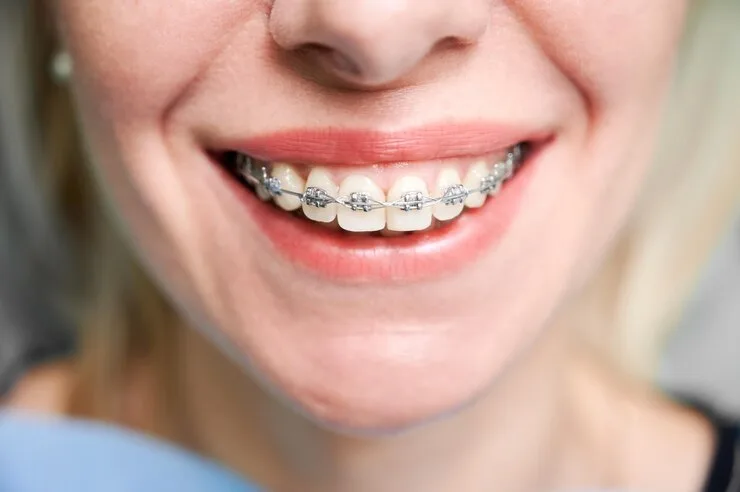
Self-ligating braces are an orthodontic system used in treatments where a special mechanism built into the bracket structure allows the archwire to be secured without the need for elastic ties or metal ligatures. In traditional brackets, wires are fixed with elastics or ligatures, whereas in this system, the bracket’s built-in clip mechanism holds the wire in place.
This system is one of the orthodontic approaches developed to guide teeth to move in a planned direction.
How Does the Self-Ligating System Work?
In self-ligating brackets, the orthodontic wire is secured with a built-in clip mechanism within the bracket. This structure may allow the wire to move more freely inside the bracket.
The clip on the bracket can be opened and closed
The orthodontic wire is placed inside this clip
Controlled forces are applied to the teeth
Through this mechanism, teeth are gradually guided into their intended positions.
What Is the Difference from Traditional Brackets?
There are some structural differences between self-ligating braces and traditional systems.
The wire is secured without the use of elastics or ligatures
A different internal mechanism exists within the bracket
The movement dynamics of the wire may vary
These differences are considered during treatment planning.
In Which Cases Are They Evaluated?
Self-ligating braces can be used in the management of various orthodontic problems.
Mild to moderate crowding
Spaces between teeth
Bite (occlusion) problems
Cases requiring realignment of teeth
Suitability is determined based on the current condition of the teeth.
What Are the Usage Features?
Due to their structural design, self-ligating brackets may offer some distinct usage characteristics.
No elastics are present on the brackets
They function with a different mechanical system
Orthodontic wires are secured within the bracket
These features may influence the technical aspects of the treatment process.
What Should Be Considered in Daily Life?
As with all orthodontic treatments, oral care habits are important in self-ligating systems.
Regular brushing of the teeth
Cleaning between teeth
Avoiding hard and sticky foods
Not skipping regular check-ups
These habits support both oral health and the treatment process.
What Is the Adaptation Process Like?
The adaptation process to self-ligating braces may vary from person to person.
A mild pressure sensation may occur in the first days
Sensitivity inside the mouth may be experienced
Adaptation usually occurs in a short time
These conditions are generally temporary.
Is It Suitable for Everyone?
This system can be evaluated in many orthodontic cases. However, it may not be suitable for every individual.
The position of the teeth is analyzed
Jaw structure is evaluated
Planning is made according to individual needs
Therefore, the treatment choice is determined on a case-by-case basis.
Frequently Asked Questions
Are self-ligating braces without elastics?
Yes, elastics may not be needed due to the built-in clip mechanism.
Do they provide faster results?
The treatment duration varies depending on the condition of the teeth.
Do they cause less pain?
Individual experiences may differ.
Are they visible?
Visibility may vary depending on the type of bracket.